
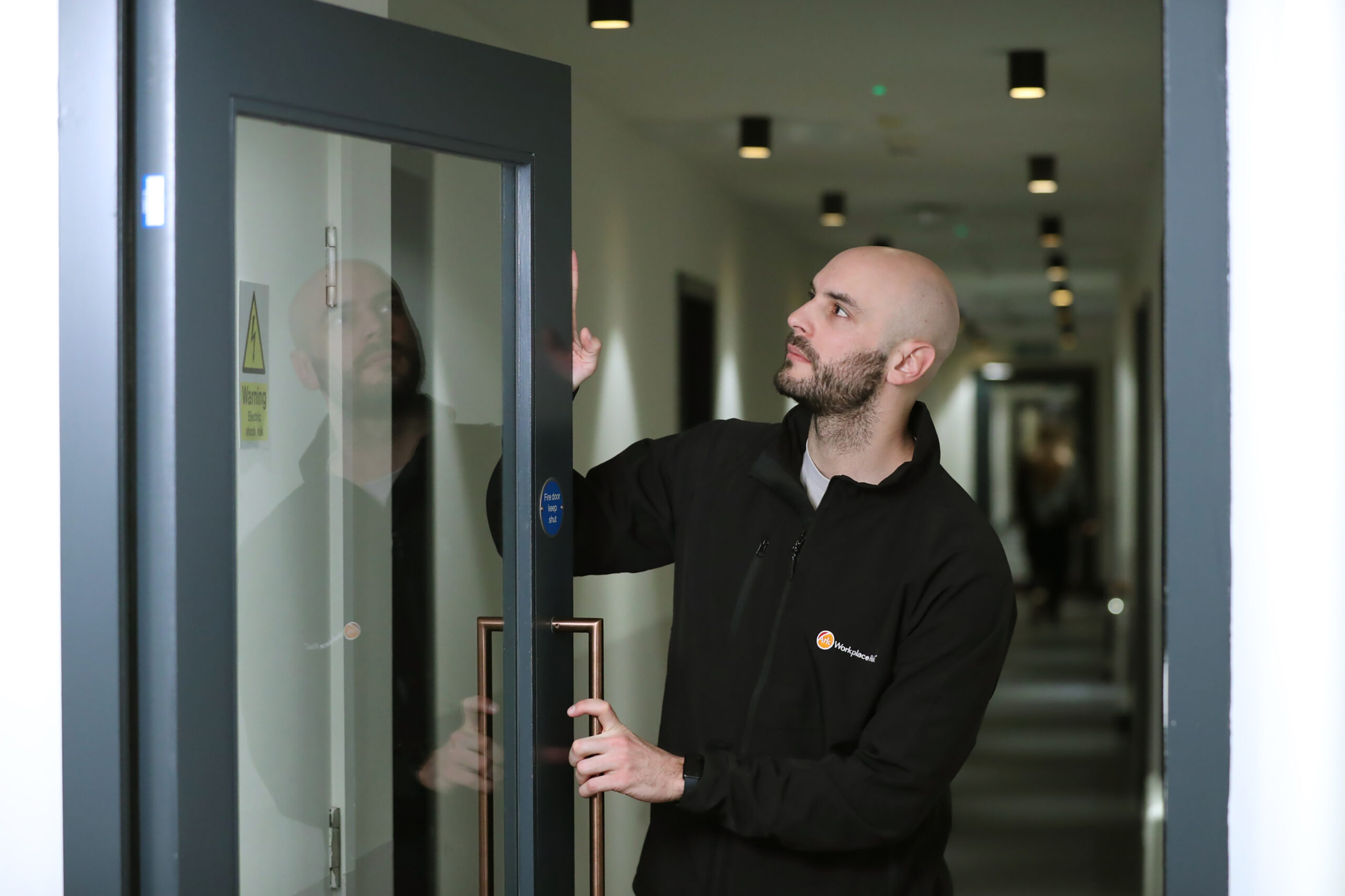
What is a fire door audit?
A fire door audit is a systematic, accredited inspection of every relevant fire door in a building. It establishes which doors are present, their fire rating, the condition of every visible component, and whether each door is capable of delivering the fire resistance it was designed for.
Our inspectors assess flat entrance, communal, riser and plant room doors, with residents able to book their own appointments through our online portal. Every door is scored, dated and evidence-linked in QUOODA®, so the results form part of your building’s Golden Thread.
You receive a clear report with prioritised findings and the actions needed to bring each door back into compliance. If remedial works are needed, we can refer you to our accredited sister company, Firetecnics Systems™, for a no-obligation quote.
Each audit gives you a baseline understanding of every door in scope, including:
- Which doors are present, such as flat entrance doors, communal doors, riser doors and plant room doors
- The fire rating of each door
- The condition and compatibility of every visible component: the door and frame, gaps at the head, jambs and threshold, intumescent strips and smoke seals, hinges and hardware, self-closer performance, and certification or labelling
- Installation quality and maintenance history
- Whether each door aligns with the building’s fire strategy and fire risk assessment
Around three-quarters of UK fire doors fail inspection
Based on over 100,000 checks by accredited inspectors, that failure rate points to systemic problems in how fire doors are installed, maintained and managed across residential and commercial buildings.
Fire doors are engineered life-safety systems. They are designed and tested to resist fire and smoke for a defined period, giving residents time to escape and the fire and rescue service time to intervene. But they only work if they are correctly specified, installed, maintained and compatible with the building’s fire strategy.
Fire door compliance isn’t a one-off task. It’s an ongoing legal and safety obligation.
Why fire door inspection matters
-
75%of fire doors inspected in 2021 failed to meet the required standards after an FDIS inspection
-
65%of social housing fire doors failed to meet the FD30 legal minimum (Sentry Doors FOI data, March 2026)
-
31%of fire door failures stem from incorrect installation from day one
-
3 monthsmaximum interval between checks of communal fire doors in residential buildings over 11 metres
How a Fire Door Audit from Ark Workplace Risk protects you

Accredited, competent inspectors
Every audit is carried out by fire safety specialists listed on the IFSM register at Tier 2 or 3.

Regulator-ready evidence
Every door is scored, dated and evidence-linked in QUOODA®, ready for the Building Safety Regulator.

Less admin for your team
Residents book their own appointments through an easy-to-use portal, saving your team time.

Residents kept informed
Direct-to-resident reporting keeps residents up to date at every stage.

Know what to fix first
Get clear, prioritised findings that set out what each door needs to bring it back into compliance.

From audit to remedial works, seamlessly
Get a no-obligation quote from Firetecnics, our accredited sister company, typically within four days.
Find out more about our service for residential buildings
Find out more about our service for commercial buildings
“Ark didn’t just identify our safety and compliance gaps, they closed them for us. Their team worked as an extension of ours, giving us the structure, insight, and confidence we needed to ensure compliance across our entire portfolio.
They’ve made Health & Safety both practical and powerful.”
Why work with Ark Workplace Risk?
- Over 30 years advising on risk, safety and compliance in the built environment
- An in-house team of multi-disciplinary experts covering health and safety, fire, structural and regulatory requirements.
- A dedicated, fully COSH-qualified Customer Success team
- An industry-leading NPS of 61
- A competent partner protecting over 200 UK clients and more than 9,000 buildings
- Multi-award-winning in both professional services and technology

Fire Doors in the UK: A Widespread Compliance Problem

Fire Doors: The First Line of Defence in Residential Fire Safety
Fire door inspection and audit frequently asked questions
The Regulatory Reform (Fire Safety) Order 2005 places a legal duty on the Responsible Person to ensure fire doors are properly maintained, based on the findings of a fire risk assessment.
For residential buildings over 11 metres, the Fire Safety (England) Regulations 2022 go further, setting out specific, legally mandated inspection frequencies for fire doors.
For residential buildings over 11 metres, the law requires communal fire doors to be checked at least every three months, and the Responsible Person to use best endeavours to check flat entrance doors at least once a year.
For buildings under 11 metres, and for commercial premises, there’s no single fixed legal frequency. Industry guidance points to inspections every six to twelve months as sensible practice, with more frequent checks for high-traffic or higher-risk areas.
A fire door audit is a systematic assessment of all relevant fire doors in a building. It establishes which doors are present, their fire rating, the condition and compatibility of every visible component, installation quality and maintenance history, and whether each door aligns with the building’s fire strategy and fire risk assessment.
In many existing residential buildings, records are incomplete, doors have been replaced piecemeal, and modifications have been made without adequate oversight. Without an initial audit, duty holders cannot confidently state whether their compartmentation is intact.
The failure is recorded as a clear, prioritised finding in your audit report, along with what’s required to bring the door back into compliance. As the Responsible Person, you’re required to act on this “as soon as reasonably practicable.”
If remedial works are needed, Ark can refer you to Firetecnics Systems™ Ltd., our sister company and accredited remedial partner, for a no-obligation quote.
Breaches of the Regulatory Reform (Fire Safety) Order 2005 can result in unlimited fines and, for the most serious offences that put people at risk, up to two years’ imprisonment.
Criminal liability rests primarily with the Responsible Person, but legal accountability can extend to other organisations and individuals. Non-compliance can also affect insurance cover and increase civil liability risk.
Look for recognised, independently verified credentials and hands-on fire safety experience. Ark’s fire risk assessors are all listed on the Institute of Fire Safety Managers (IFSM) register at Tier 2 or 3, and our fire risk assessments are BAFE SP205 certified. Our multi-disciplinary fire safety team has proven experience across residential and commercial buildings, and our audits integrate with Safety Case Reports, Resident Engagement Strategies and digital compliance tracking.
Remedial works should be carried out by a competent, accredited contractor. Ark can refer you to Firetecnics Systems™ Ltd., our sister company and passive fire protection specialist. Firetecnics are operationally independent from Ark and hold FAS and SafeContractor accreditations, with experience ranging from minor remedial work to multi-building fire safety programmes.
Once your audit findings are ready, you can choose to have us pass your report to Firetecnics, who manage quotation, review and delivery. Quotes are typically turned around within four days, with works completed within three to six weeks.
The Responsible Person, usually the building owner, landlord or managing agent, is responsible for fire doors in the communal parts of the building, including flat entrance doors. In residential buildings over 11 metres, they must also check communal fire doors at least every three months, use best endeavours to check flat entrance doors at least once a year, and give residents information about the importance of fire doors.
Ready to book in your Fire Door Audit?
Whether you’re ready to book or you would like to discuss the process with a member of the team, Ark is your trusted partner for safer buildings and stronger governance.