
Introduction
Digital risk‑management platforms are now essential infrastructure for any property management or owner that is serious about health and safety, building safety, and fire safety. QUOODA®, Ark’s governance, risk and compliance platform, stands out because it provides a unified, evidence‑ready compliance environment, grounded in our understanding of the sector and designed specifically for the built environment.
Across the UK property sector, the regulatory landscape has and is shifting. The Building Safety Act, Fire Safety (England) Regulations, and long‑standing frameworks such as ISO 45001 and HSG65 demand consistent evidence, auditable processes, and real‑time oversight. Manual systems, spreadsheets, email trails and siloed documents, just cannot meet these expectations at scale.
Nationally recognised guidance from the HSE, the Building Safety Regulator, and the Home Office all emphasise the same themes, the need for:
- Digital management of evidence
- Clear lines of accountability
- Robust risk assessment and monitoring
- Competent management of contractors and supply chains
- Timely action tracking and escalation
Technology is not a “nice to have”; it is the only practical way to maintain a defensible position across both small and large, complex portfolios.
The role of risk‑management platforms
Modern compliance platforms support property owners and managers by:
- Centralising assessments, documents, and audit trails
- Providing live dashboards to identify emerging risks
- Automating task allocation, reminders, and escalations
- Supporting mobile, on‑site data capture
- Enabling consistent processes across diverse assets
- Maintaining a single source of truth for regulators, insurers, and boards
These capabilities directly align with the expectations of the Building Safety Regulator, the HSE, Local Fire and Rescue Services along with internationally and nationally recognised management system standards.
How QUOODA® supports health, safety, building safety and fire safety
QUOODA® is a risk, compliance, and safety management platform designed specifically for the built environment, used across thousands of buildings and by thousands of users. It provides a centralised, modular environment for managing health and safety, fire safety, and building safety obligations.
Key capabilities include:
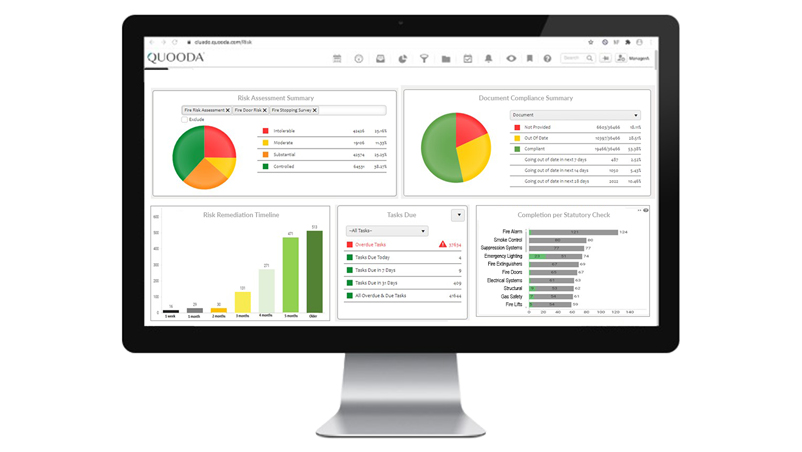
- 360° visibility of compliance status across portfolios, with drill‑down dashboards for risk, actions, and documentation
- A single source of truth, capturing assessments, documents, and evidence in one place, including renewal tracking and audit trails
- Task management with automated notifications and escalations, ensuring actions are completed on time and accountability is clear
- Mobile app functionality, enabling on‑site checklists, updates, and incident reporting
- Support for ISO‑aligned processes, including ISO 45001 health and safety management
- Comprehensive assessment storage, enabling property teams to access, filter, and manage all assessment types efficiently
These features directly support the operational requirements of health and safety management, fire risk assessment oversight, building safety case evidence, and ongoing compliance monitoring.
How QUOODA® differs from other systems
Many compliance platforms offer document storage or task lists. QUOODA® differentiates itself in several ways:
- Designed specifically for the built environment – unlike generic EHS or workflow tools, QUOODA® is built around property portfolios, asset hierarchies, and the realities of managing multi‑site estates. It is used across more than 8,000+ buildings, confirming sector‑wide adoption.
- End‑to‑end compliance lifecycle management – QUOODA® supports the full chain, from assessments to actions to evidence, form working on the move to reporting and decision making. Rather than isolated modules QUOODA® is connected and robustly designed that provides for “whole‑building” oversight. In alignment with regulator expectations.
- Market-leading evidence management – the platform emphasises audit‑ready documentation, renewal tracking, and a single source of truth, critical for day-to-day management, golden thread and safety case evidence management.
- Mobile operational capability – on‑site teams can complete checklists, update risks, and raise actions directly from the field, reducing lag between identification and resolution.
- Configurable to organisational processes – with its modular architecture and flexible design, QUOODA® allows alignment with internal procedures and recognised standards, rather than forcing a rigid workflow.
- Integrated task accountability – automated escalations and clear assignment pathways help ensure issues are not missed, an area where many systems rely on manual follow‑up.
- Evidence‑based performance insights – native dashboards and analytics help identify trends and systemic issues, supporting proactive risk reduction.
This matters for property owners and managers, as we’re in a sector where:
- compliance failures lead to personal prosecution,
- insurers demand demonstrable risk control,
- residents expect transparency, and
- regulators require structured evidence,
QUOODA® provides clarity, consistency, and confidence, without claiming to replace competent people, professional judgement, or statutory duties.
QUOODA® does not eliminate risk, guarantee compliance in isolation, or replace the need for competent assessors or safety professionals. But it does provide the infrastructure to manage obligations effectively, demonstrate control, and maintain a defensible position.
Conclusion
Risk management technology is now a strategic necessity within the property management sector. QUOODA® offers an evidence‑based, sector‑aligned, and operationally practical solution that helps property organisations meet their health and safety, building safety, and fire safety duties with greater confidence, visibility, and efficiency, without overstating what technology alone can achieve.
Contact us to discuss how QUOODA® can support your building management, safety, and compliance obligations with greater confidence and visibility.